Deep dive · Amazon Livestream
Simplifying Livestream Setup for High-Pressure Events
How Operators went from juggling a fragmented, multi-tool setup process to running Livestream events for up to 160,000 concurrent viewers from a single workspace.
Part 1
What is Amazon Livestream?
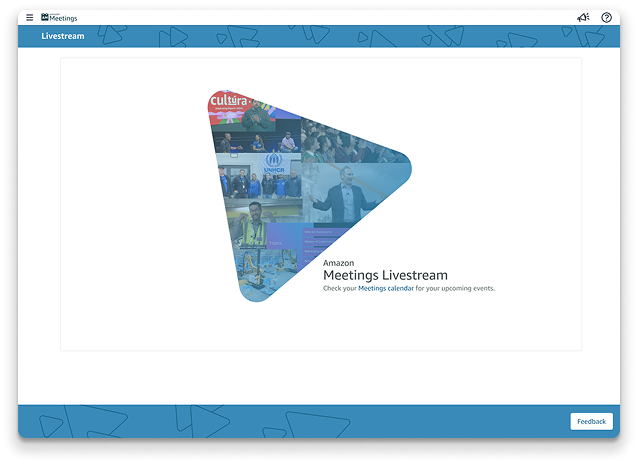
Amazon Livestream, the meetings tool company leaders used to host company-wide broadcasts.
Company leaders relied on Amazon Livestream to host high-impact virtual meetings of up to 10,000 events a year, with audiences as large as 160,000 concurrent viewers.
Part 2
Who are the users?
Organizers
Sought consistent branding aligned with each event's theme and message.
Presenters
Wanted real-time feedback to gauge audience engagement.
Viewers
Desired interactive opportunities to ask questions and participate.
Operations
Needed reliable tools to monitor and manage event performance smoothly.
Part 3
What was the user problem?
Zero tolerance for error
Operations were discovering setup issues during the live event itself. The platform had grown across multiple disconnected tools, and every new tool added complexity to getting an event ready to go live - with thousands of viewers already waiting online.
Part 4
UX challenge (working hypothesis)
How might we…
How might we simplify Livestream setup to reduce issues and give Operators confidence during high-pressure live events?
Part 5
What was the current process?
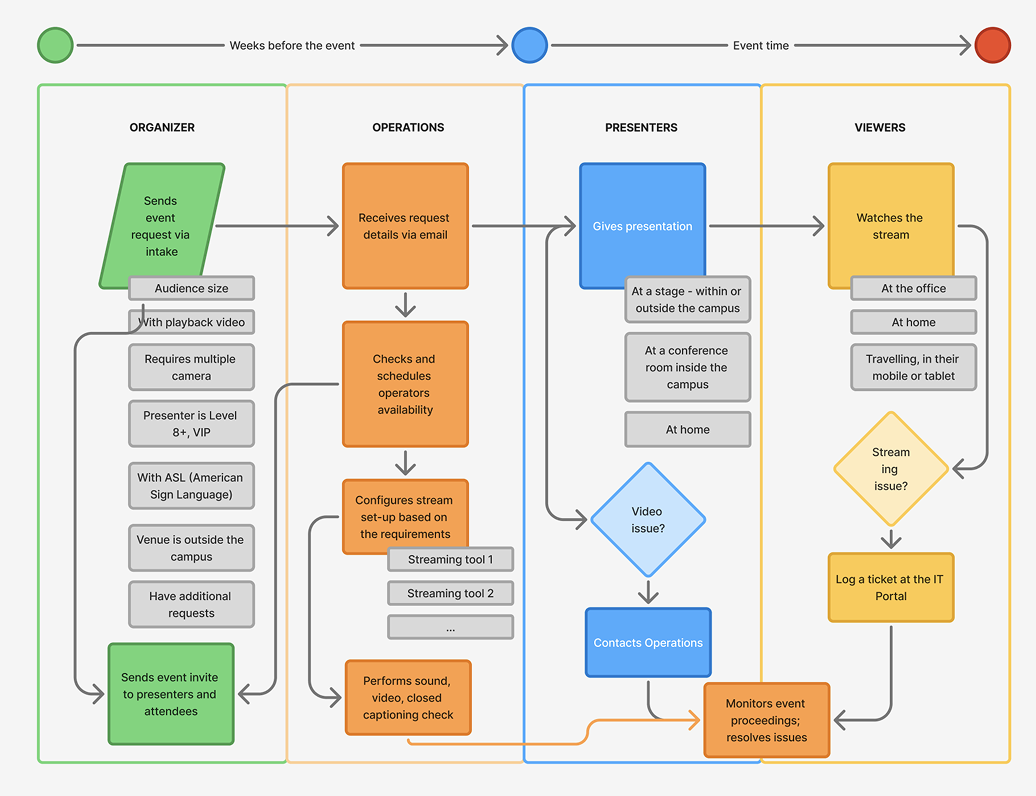
Mapped the end-to-end setup process across all four roles, from weeks before the event through event time.
Part 6
What was the quick insight?
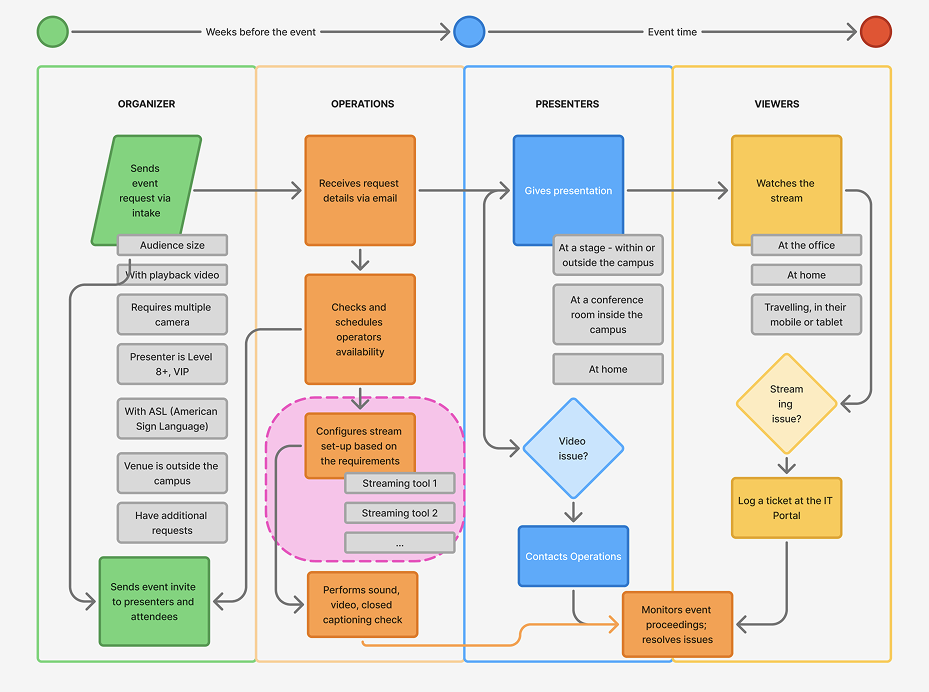
Highlighted where the process actually broke: the setup step Operations owned.
Quick insight
The failure point was the setup process itself, spread across multiple disconnected tools. The more complex an event's requirements, the more complex setup became and the higher the risk of error.
Part 7
Deep-dive into the current process
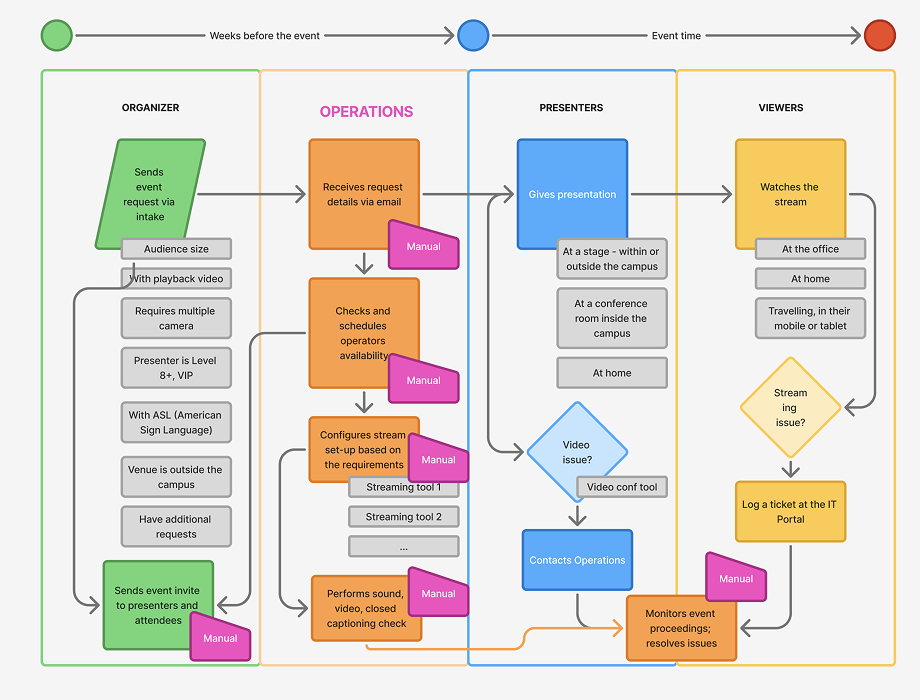
Marked every manual step Operations had to carry out just to get one event live.
Key insight
We were making Operators responsible for monitoring fragmented tools and processes just to run a single Livestream event.
Updated UX challenge
How might we give Operators a coherent mental model to manage the Livestream process?
Part 8
What was the proposed design solution?
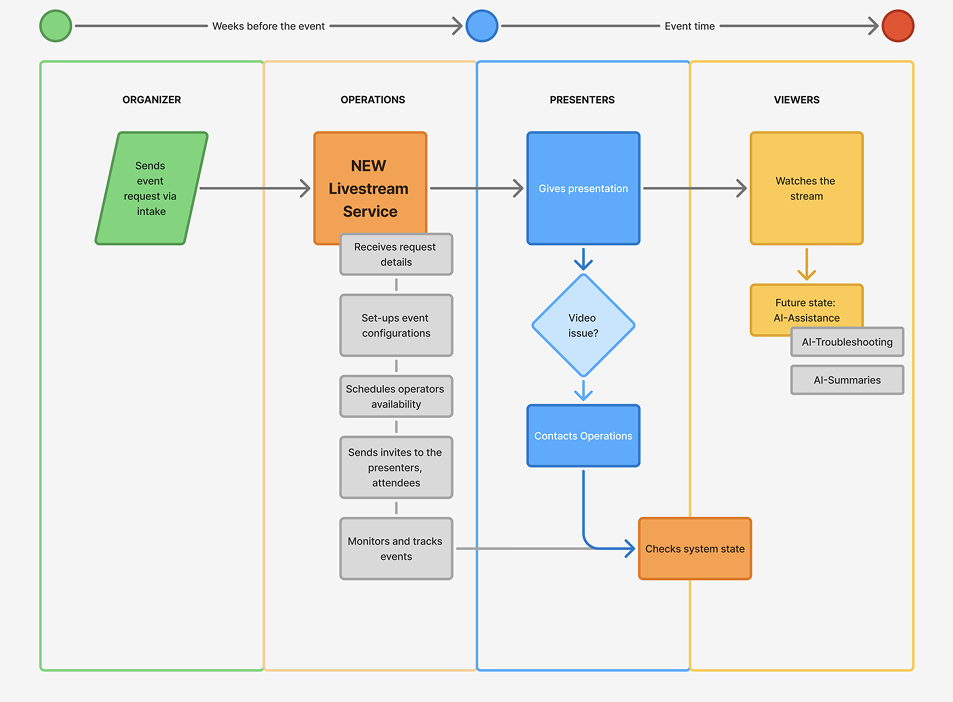
Collapsed the manual Operations steps into a single, consolidated Livestream service, with AI-assisted troubleshooting and summaries scoped as a future state.
Automate and consolidate planning, scheduling, setup, and production into a single operational workspace, not just enhance a single interface or process.
Part 9
What does the design solution look like?
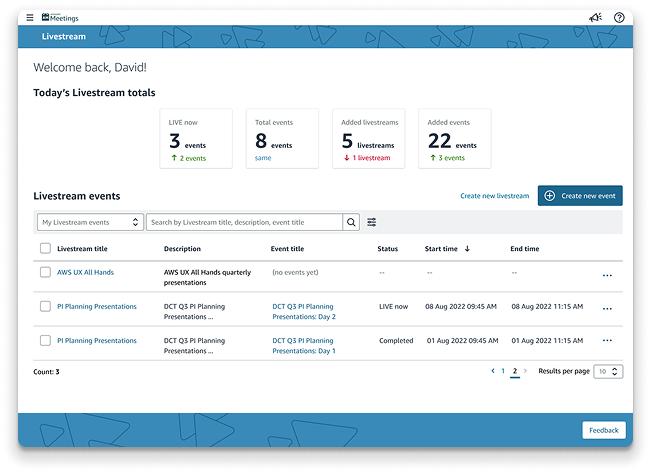
The unified operator dashboard: setup, scheduling, and live event status in one workspace.
A unified interaction framework so Operators could complete setup from a single workspace.
Automated common event workflows while preserving flexibility for advanced production scenarios through configurable options.
Part 10
Impact
Results
↓ 40%
Event setup effort, with recurring workflows automated
Setup effort dropped 40% while common event workflows were automated end to end. Operators also reported greater confidence managing high-pressure live events from a single workspace, instead of switching between disconnected tools.
Part 11
Learnings and reflections
Learning
Every feature has a cost - in development and in maintenance, especially for a project at Amazon's scale. Staying clear on the main priorities and cutting anything unnecessary, mattered as much as the design itself.