Amazon Prime Video Shorts
Turning long-form content into moments customers want to watch
The opportunity
Prime Video has an enormous catalog of movies, TV shows, and live content. However, having more content doesn't necessarily make it easier for customers to discover something they want to watch.
At the same time, short-form video has fundamentally changed how people discover content.
Platforms such as YouTube Shorts and Instagram Reels have demonstrated the scale of this behavior, reaching roughly 2 billion monthly active users. Short-form video is particularly effective at capturing attention, creating curiosity, and helping people quickly decide whether something is worth watching.
This created an opportunity:
What if Prime Video could use the same short-form discovery behavior to help customers discover content already available on Prime?
Instead of asking customers to search through a large catalog, Prime Video could bring the content to them — one compelling moment at a time.
The problem
Prime Video has a discovery problem, not a content problem.
Customers have access to thousands of movies and shows, but discovering something new can require significant effort. The traditional journey looks something like:
Every additional step creates an opportunity for customers to abandon the discovery journey.
There is also a second problem:
Great content can remain invisible.
New releases, older catalog titles, and partner content compete for limited attention on the Prime Video home experience. A customer may never encounter a title simply because it doesn't appear in the surfaces they browse.
The hypothesis
I hypothesized that short-form video could become a new discovery layer for Prime Video.
Rather than relying primarily on posters, metadata, and trailers, customers could discover movies and shows through short, highly engaging moments from the actual content.
The experience could create a new loop:
Why Shorts?
Short-form video introduces a fundamentally different discovery behavior. Instead of asking:
“What do I want to watch?”
the experience asks:
“Do I want to see what happens next?”
That distinction is important. A traditional content card communicates primarily through:
A Short can communicate through the actual emotional or narrative experience of the content.
The customer doesn't need to understand the entire premise before deciding whether they're interested.
Inspiration from Amazon Livestream
This concept originated from an earlier opportunity I explored as the UX Designer for Amazon Livestream.
Amazon Livestream has a large library of live events, with 10,000+ livestreams annually. However, the value of a livestream doesn't necessarily end when the event ends.
I identified an opportunity to use AI to transform long-form livestreams into short, discoverable moments.
The concept
AI would analyze livestream content and surface important or engaging moments, creating short clips that could be consumed independently. The experience would then provide a direct path from:
This helped establish a broader product principle:
I saw an opportunity to extend that principle beyond livestreaming and into Prime Video.
From livestream discovery to Prime Video
The Prime Video opportunity became:
Prime Video Shorts
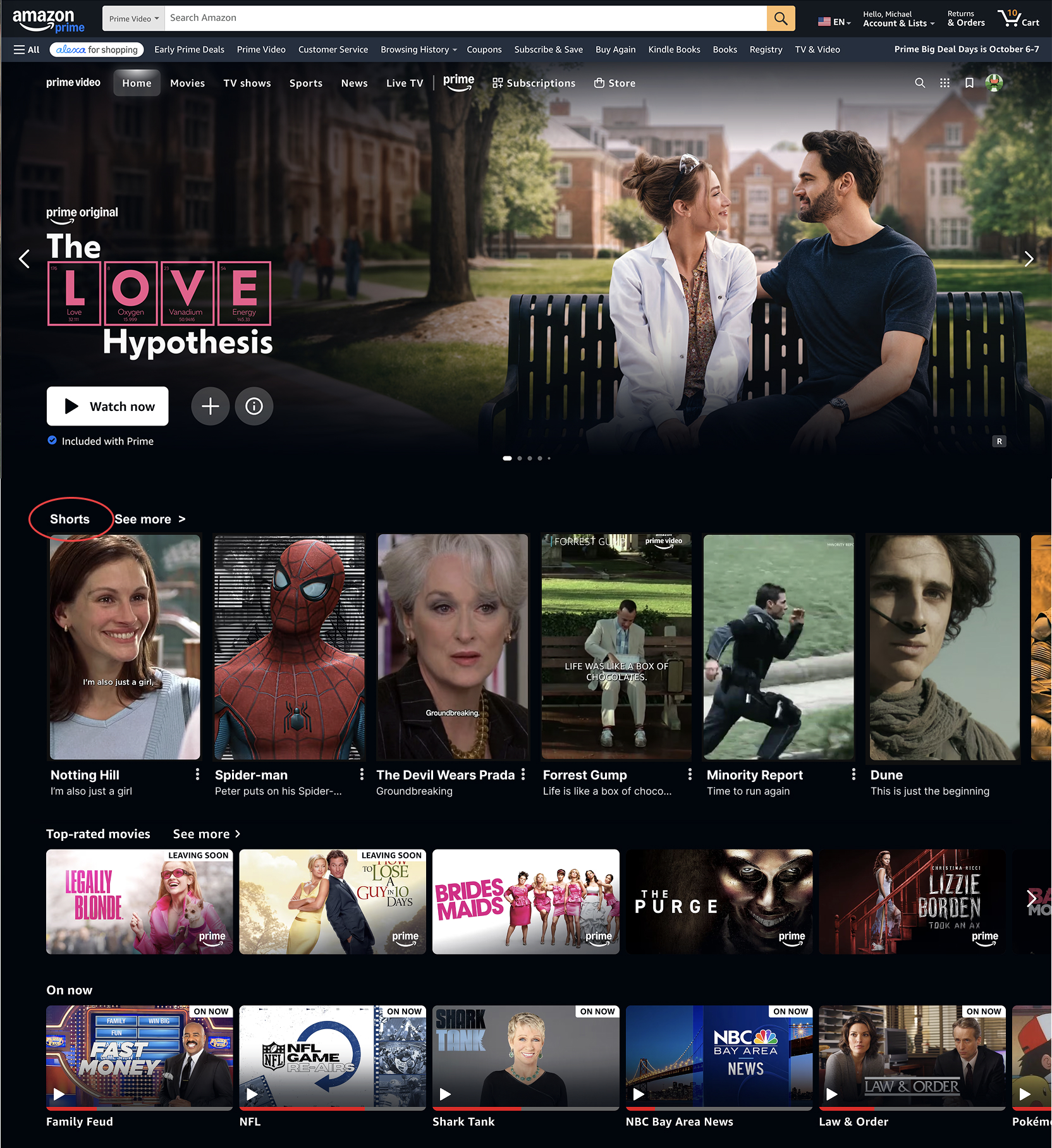
A dedicated short-form discovery experience where customers can browse clips from movies and TV shows available on Prime Video.
Each Short becomes an entry point into the larger Prime Video catalog.
Instead of replacing the traditional Prime Video browsing experience, Shorts would complement it by creating a more exploratory way to discover content.
The experience
At a high level, the experience consists of four key interactions:
Customers encounter a dedicated Shorts surface within Prime Video. They can vertically browse clips much like other short-form video experiences.
The content plays immediately, allowing customers to understand the tone, characters, story, or value of a title without reading a description.
When a customer finds something interesting, the Short provides a direct path to the corresponding movie or TV show. Watch now takes the customer directly into the full-length experience.
If the customer isn't ready to watch, they can save the title to their Prime Video list for later. A Short doesn't have to result in an immediate viewing session to create value.
The proposed user journey
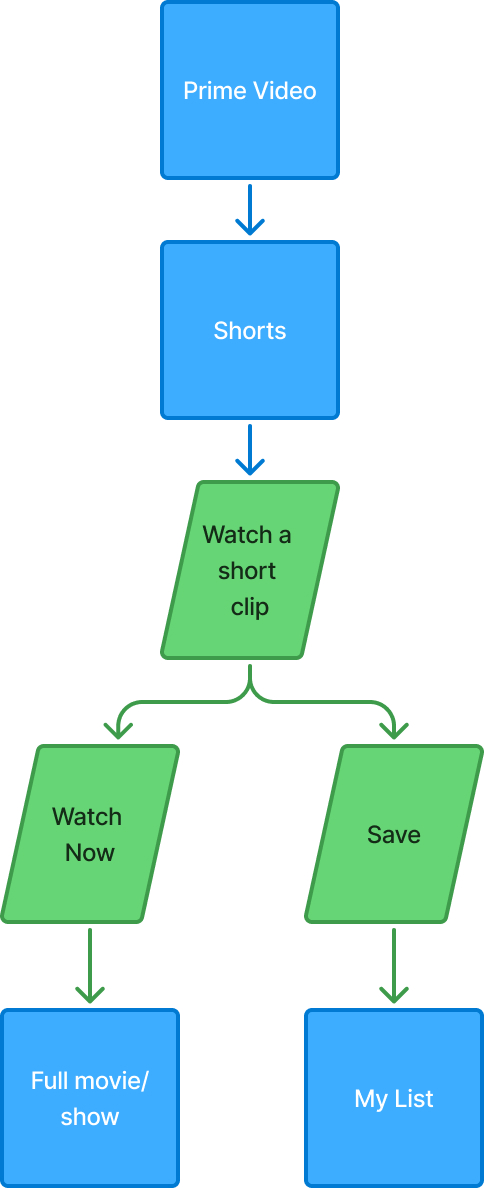
The important design principle is that discovery and viewing remain connected.
The customer shouldn't have to leave the discovery experience, remember a title, search for it again, and then find the movie.
The content itself becomes the navigation.
Core experience
The Shorts feed
The primary experience would use a vertical, full-screen feed. Each Short would contain:
The primary discovery mechanism.
- Movie/show title
- Genre
- Optional episode/season context
Watch now
Add to List
Additional discovery: Customers can continue swiping to discover additional content.
AI as the content engine
A major part of the opportunity is that manually creating Shorts for a large catalog would be difficult and expensive. AI could potentially identify moments based on signals such as:
Personalization opportunity
Once Shorts exist as a discovery surface, the experience can become increasingly personalized. Rather than showing the same sequence to everyone, Prime Video could potentially use existing signals to tailor discovery.
A customer who watches crime dramas could see more crime-related Shorts.
Comedy, sci-fi, drama, animation, etc.
Shorts could introduce related titles.
Shorts could surface content similar to titles already in the customer's list.
Customers could discover newly added movies and shows through their most compelling moments.
This turns Shorts from a static content shelf into a personalized discovery engine.
A new content discovery loop
The broader product opportunity can be represented as a loop:
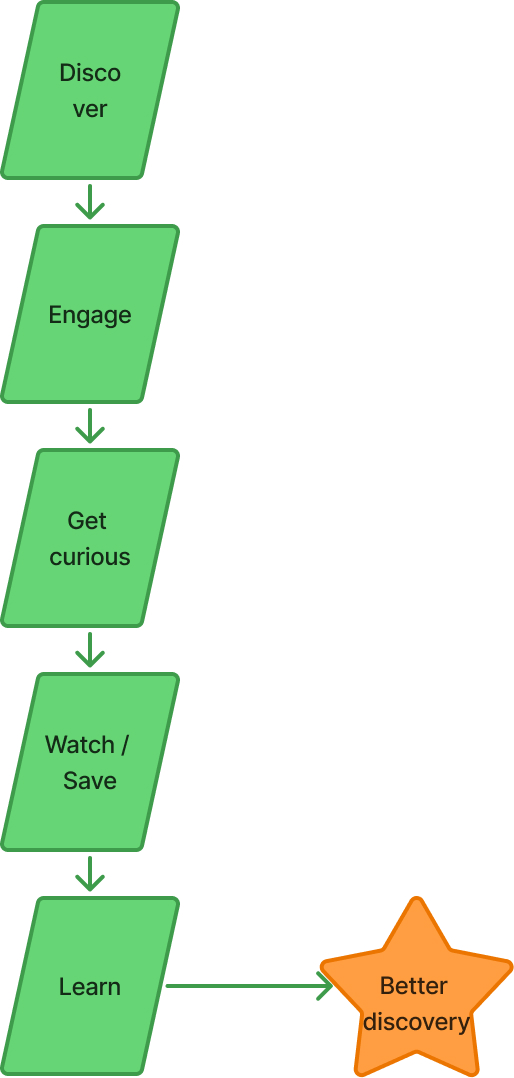
Every interaction creates additional signals that can improve future recommendations.
Business opportunity
The strategic value extends beyond creating another video format.
- Easier content discovery
- More engaging browsing
- Less decision fatigue
- Personalized recommendations
- Faster path to content they enjoy
- Greater catalog discovery
- Increased engagement
- More exposure for new releases
- Additional opportunities for personalization
- Increased long-form viewing
- Additional promotional surface
- More exposure for their movies and shows
- New way to introduce characters and stories
- Potential increase in title starts